Section 02
Build Variants
The F355 was built from 1994 to 1999, and Ferrari changed meaningful things along the way. This is the production timeline — when each spec was introduced, and what arrived with it. Cars built during a transition window can sit on either side of a change; the build date is what matters.
1994
1994
The first cars leave Maranello
LaunchFerrari launches the F355 as a Berlinetta only. The earliest production cars carry the purest specification — a single-ECU Bosch Motronic 2.7, no driver airbag, and the original three-spoke Momo Corse steering wheel. Output is deliberately slow as Ferrari validates an all-new five-valve V8 platform.
In production:BerlinettaLaunched with
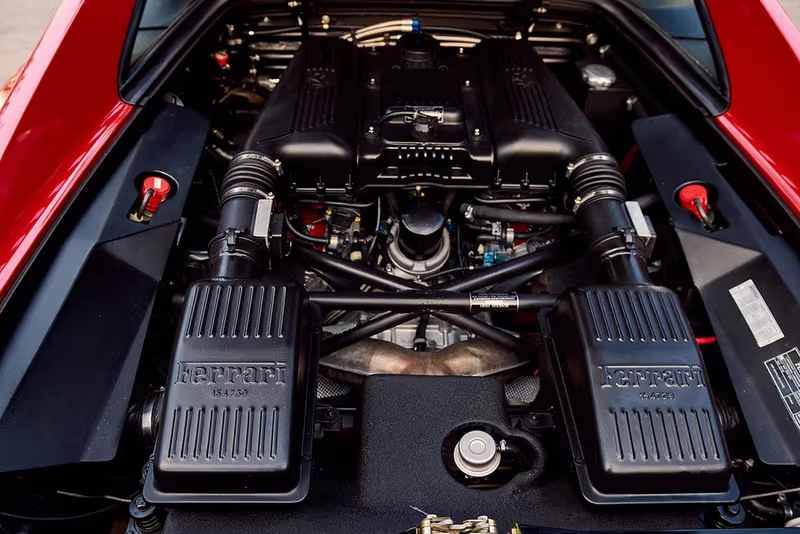
Motronic 2.7 ECU
Single Bosch ECU controlling both cylinder banks, with one throttle body per bank. Simpler, raspier, more analog throttle response.
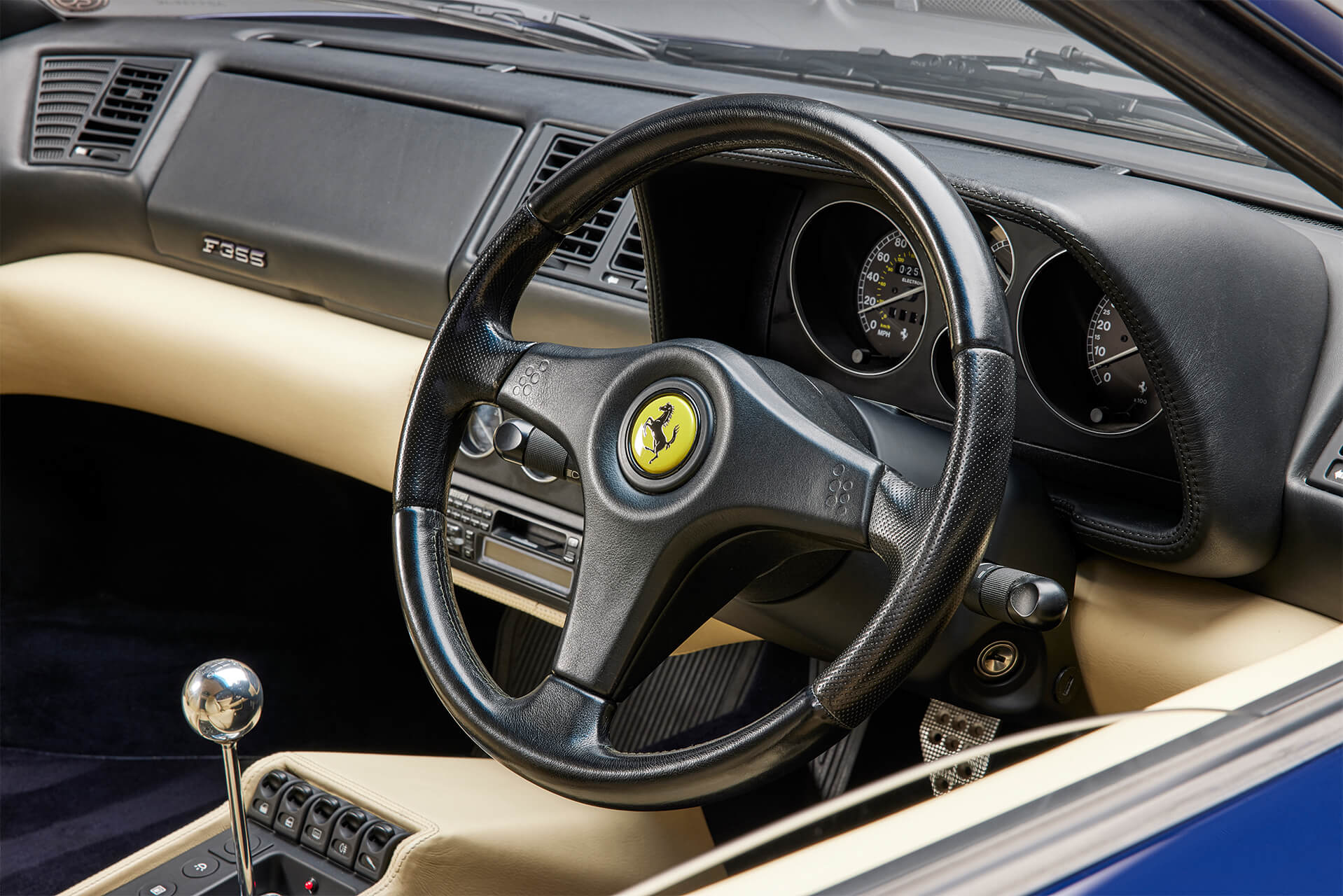
Three-spoke Momo wheel
Period-correct three-spoke Momo Corse steering wheel with a smooth wood-and-leather centre boss — no airbag.
Early 1995
Early 1995
The GTS arrives — still 2.7, still three-spoke
GTS launchThe targa-roof GTS joins the Berlinetta. Crucially, the earliest 1995 GTS cars share the original spec with the launch Berlinettas — Motronic 2.7 ECU, no airbag, and the factory three-spoke Momo Corse wheel. They are scarce but they exist, and a documented early-'95 2.7 GTS is one of the rarest road 355s.
In production:BerlinettaGTSIntroduced
GTS body style
Targa-roof GTS launched alongside the Berlinetta. Earliest builds are 2.7 ECU with the three-spoke wheel — most surviving 2.7 GTS cars come from this short window.
Mid 1995
Mid 1995
Safety regs catch up — airbag wheel arrives
Driver airbagA driver-side airbag becomes standard across both body styles, replacing the slim three-spoke Momo with the OEM three-spoke airbag wheel — same spoke count, but a much larger central airbag module. The Motronic 2.7 ECU is still fitted on cars built around this window; the ECU change comes a few months later.
In production:BerlinettaGTSIntroduced
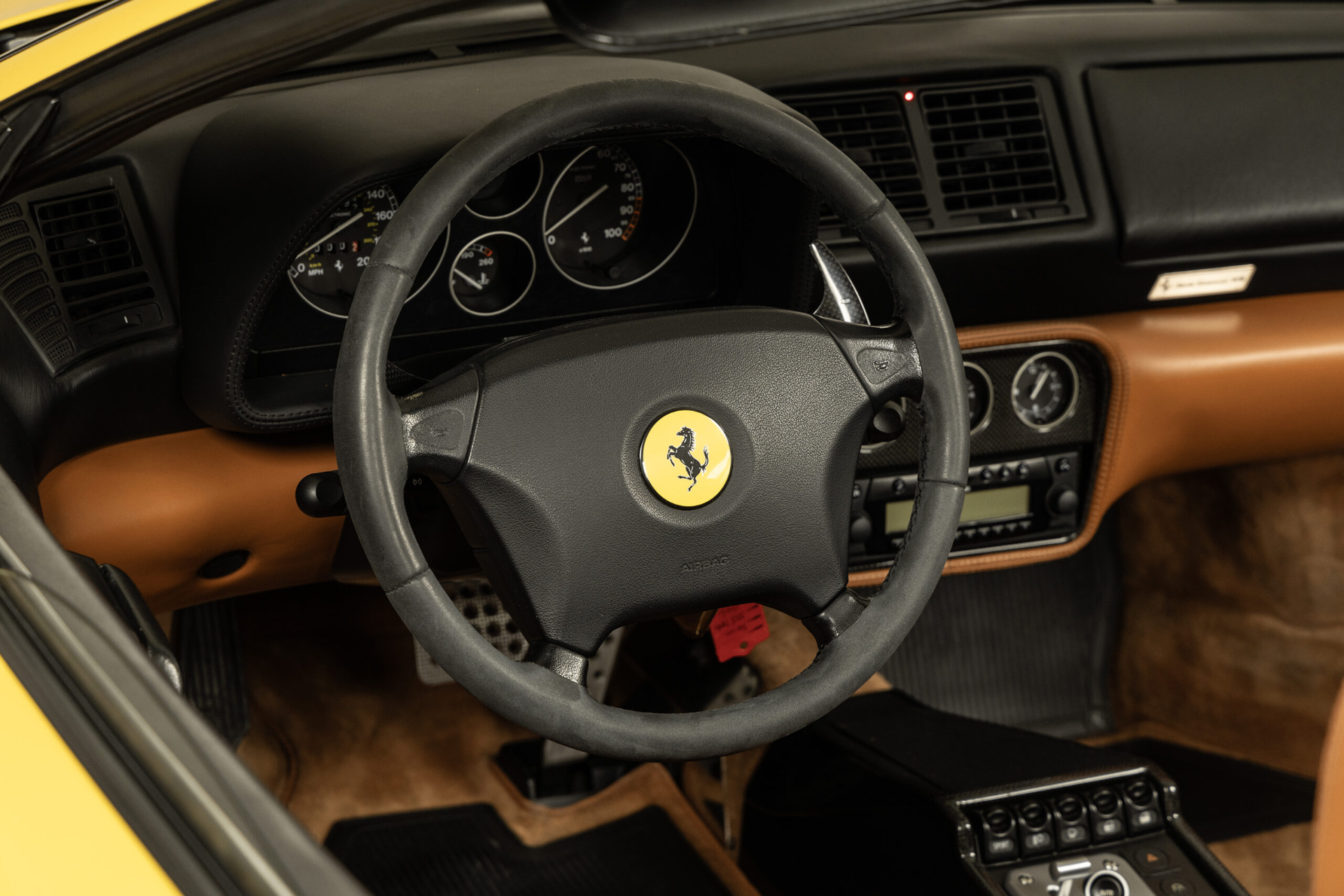
Three-spoke airbag wheel
OEM three-spoke wheel with a large central airbag module replacing the smooth Momo Corse boss. End of the factory pre-airbag spec on both Berlinetta and GTS.
Late 1995
Late 1995
The dual-ECU system arrives
Motronic 5.2Production transitions to the Bosch Motronic 5.2 engine management system — two ECUs, one per cylinder bank, with two throttle bodies per bank. Smoother, smarter, and required for the upcoming OBD-II compliance window in the US. From this point on the 2.7 cars become a separate, sought-after collector spec.
In production:BerlinettaGTSIntroduced
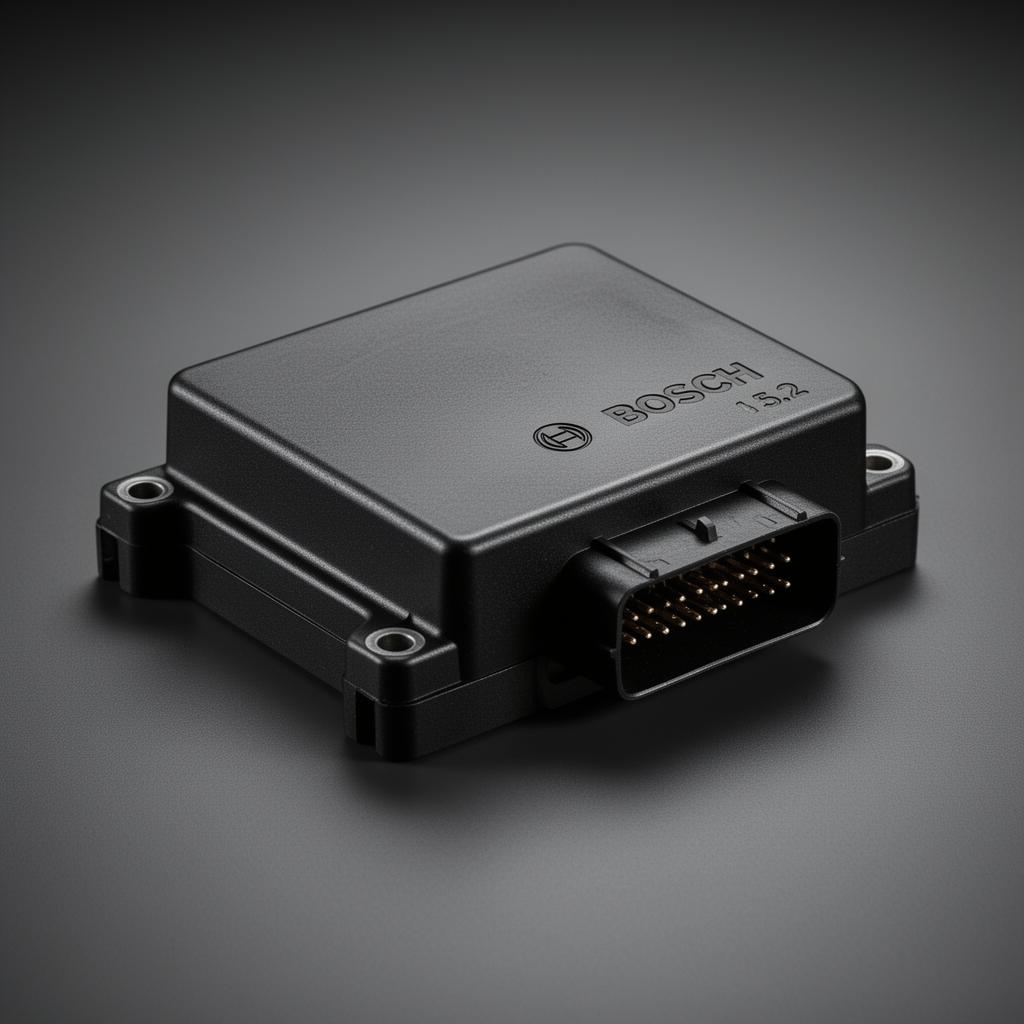
Bosch Motronic 5.2
Dual-ECU system with four total throttle bodies. Cleaner idle, refined part-throttle response, OBD-II ready for 1996 US compliance.
1996
1996
The convertible joins the family
SpiderThe full convertible Spider enters series production for the 1996 model year, completing the three-body road-car lineup. All Spiders are Motronic 5.2 — there is no factory 2.7 Spider. The Challenge race series also debuts in this window, based on the Berlinetta.
In production:BerlinettaGTSSpiderChallengeIntroduced
Spider body style
Full power-folding convertible. Always Motronic 5.2 — no factory 2.7 Spider exists.
Challenge race spec
Stripped, caged, race-prepared Berlinettas built for the F355 Challenge one-make series.
1997
1997
Paddle-shift comes to a road Ferrari
F1 transmissionFerrari introduces the F1 paddle-shift automated manual — the first electrohydraulic gearbox on a road-going Ferrari. The same gated 6-speed manual remains available alongside it. F1 cars are mechanically identical to manuals; the difference is the actuation.
In production:BerlinettaGTSSpiderChallengeIntroduced
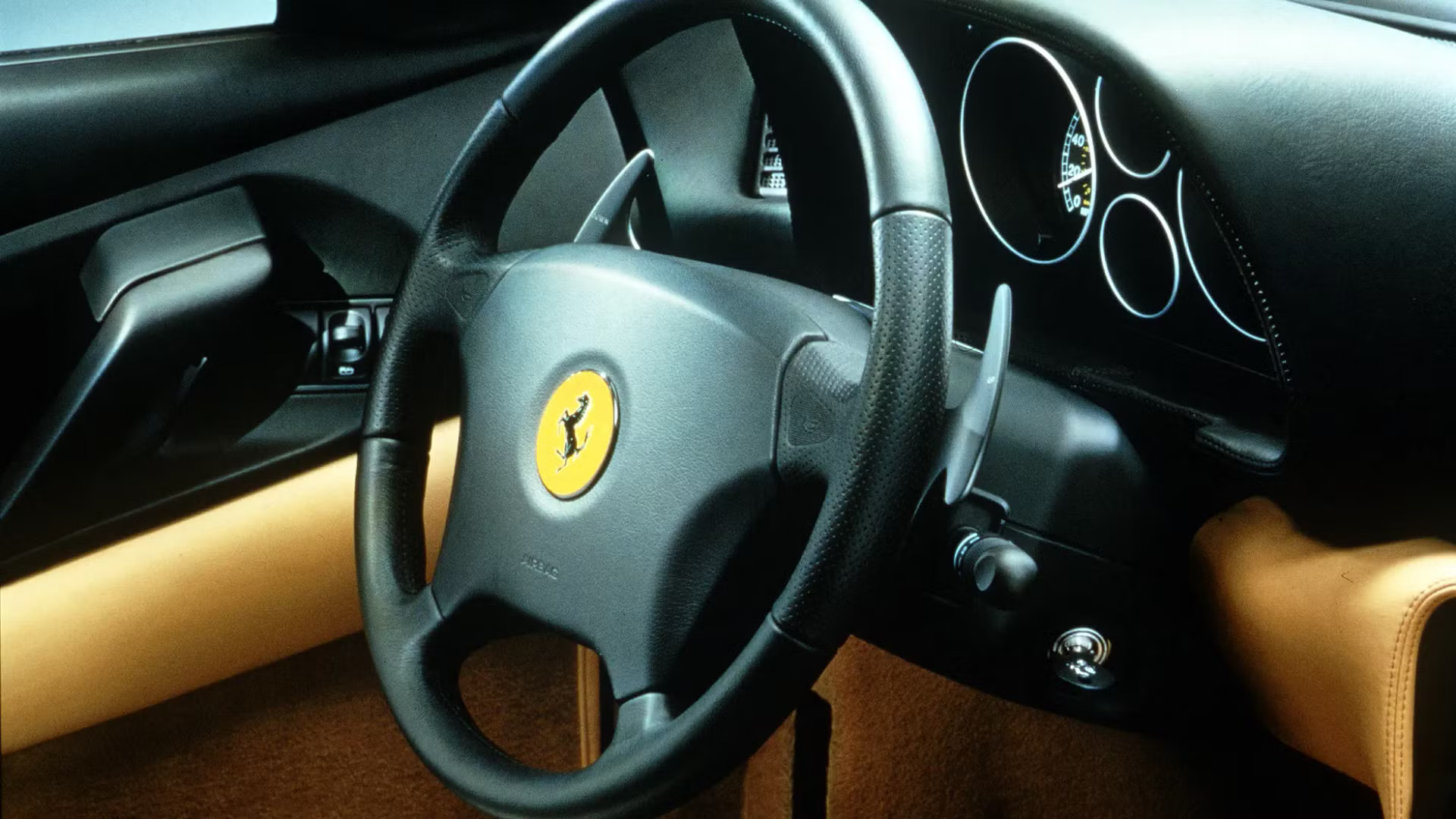
F1 paddle-shift gearbox
Electrohydraulic actuation of the same 6-speed gearbox. Magnesium paddles behind the wheel, no clutch pedal.
1999
1999
The send-off — final 100 Spiders
Serie FioranoFerrari closes the F355 production run with the Serie Fiorano — a final 100 Spiders with hydraulic-assisted steering, drilled aluminium pedals, carbon-fibre interior trim, and a Fiorano badge on the dashboard. End of the line for the five-valve V8 in this chassis; the 360 Modena follows.
In production:BerlinettaGTSSpiderSerie FioranoChallengeIntroduced
Serie Fiorano package
Final 100 Spiders. Hydraulic power steering, drilled pedals, carbon trim, dash plaque. End of production.
Go deeper
Engine ECU specs in detail
The two Bosch Motronic systems and the early '94 spec each have their own dedicated write-up. The ECU is one of the most-checked items on a 355 PPI — and one of the easiest things to get wrong if you don't know what you're looking at.
1994 (Berlinetta only)
Early '94
The very first F355s built — 1994 Berlinettas only. They share the Motronic 2.7 ECU with the rest of the early production run, but they have two further distinctions that collectors track separately: no driver airbag (a smooth wood/leather centre boss) and the original three-spoke Momo steering wheel. These three traits — 2.7 ECU, no airbag, 3-spoke wheel — define the purest early-spec car.
Read the full spec →
1994 – early 1995
2.7 Motronic
All very early F355s used the Bosch Motronic 2.7 engine management system — one ECU controlling both banks, with a single throttle body per bank. The 2.7 cars are mechanically identical to later cars in displacement and architecture, but the management is simpler and many enthusiasts feel the throttle response is more analog. Production crossed over to Motronic 5.2 during 1995, so 1995 cars can be either system depending on build date.
Read the full spec →
Mid-1995 – 1999
5.2 Motronic
The Motronic 5.2 system uses two ECUs — one per bank — with separate throttle bodies. It is more refined, slightly cleaner running, and is what the vast majority of F355s left the factory with. All GTS and Spider cars from 1996 onwards, all Serie Fiorano cars, and all later Berlinettas use the 5.2 system. Note: in our database the engine field labelled '3.5' is the same Motronic 5.2 management system — the displacement is 3.5 litres on all cars.
Read the full spec →
Continue reading