Section 06
Modifications
Two flavours of modification dominate the F355 world: tasteful character upgrades the community broadly accepts as period-correct, and the more involved weight and performance changes owners reach for when they want to sharpen the car. We're describing what people actually do — not picking sides.
Golden rule
Whatever you fit, keep the original parts boxed and labelled. They protect future value, they keep the Classiche door open should the next owner want to walk back to factory, and increasingly the originals themselves are the rare item — fewer untouched cars survive every year.
On Classiche
Ferrari Classiche certification requires the car to be in original factory specification. Most of the popular F355 modifications below — exhausts, headers, suspension, brakes — will disqualify a car from Classiche as fitted. That does not mean they hurt value: a well-known, tastefully-executed Capristo or Tubi system, for example, is widely seen by the owner community as a desirable upgrade and frequently sells for a small premium over a tired-OEM-exhaust car. The combination that pleases the most buyers is: tasteful upgrades fitted, original parts kept and documented, ready to revert.
Character & sound — community-accepted upgrades
Modifications the F355 owner community broadly considers period-correct or tasteful improvements. While not Classiche-eligible, these are commonly seen on cared-for cars and often add to perceived value provided the work is well-executed and the originals are preserved.
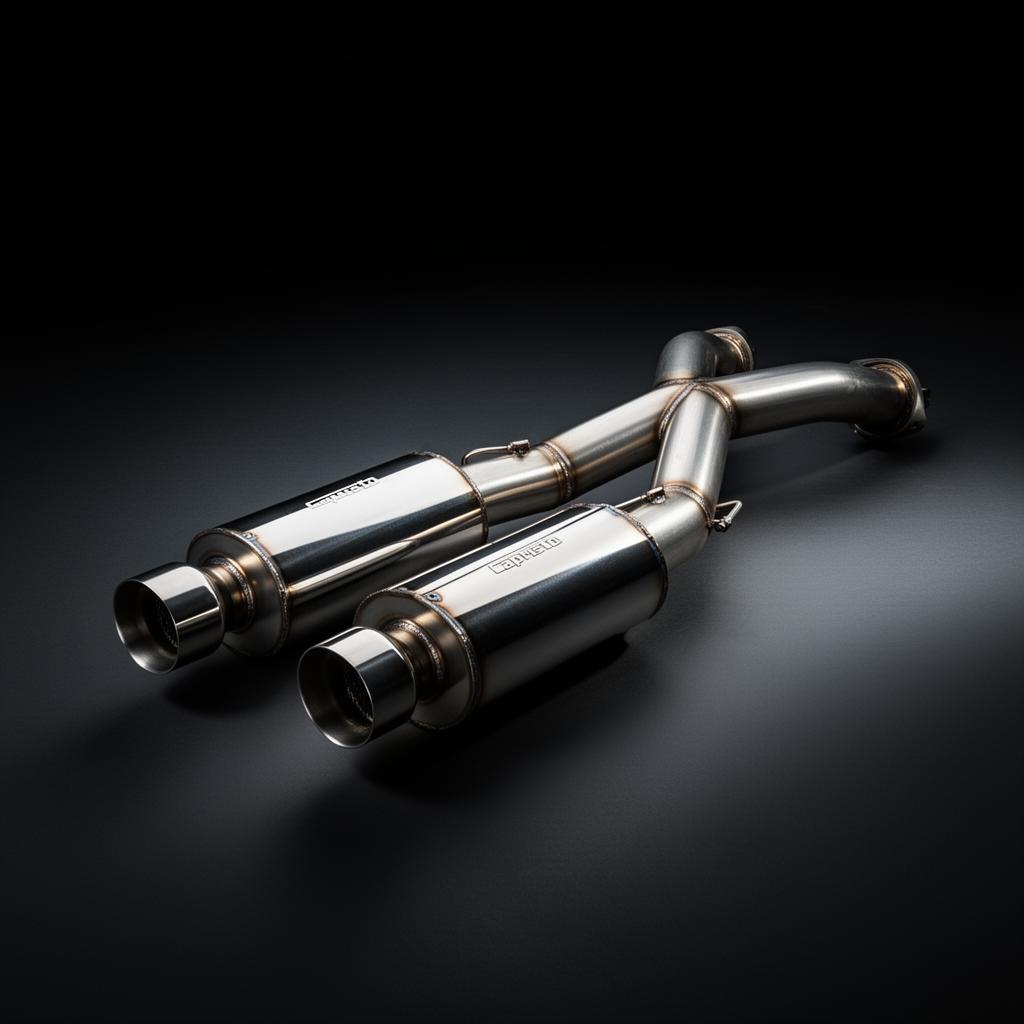
Capristo exhaust system
$3,500 – $7,500 fitted
What it is
German-made stainless cat-back exhaust, often with valved bypass. Available as straight-through or with electronic valve control from the cabin. The de-facto premium upgrade in the F355 world.
Why owners do it
Releases the V8 voice the OEM system muffles — the top end gains the howl that defines the engine. Build quality and fitment are factory-grade. Resale-friendly: a documented Capristo system is a positive line item, not a negative.
Trade-offs
Loud at idle and on cold start. Not Classiche-eligible. Cheaper copies exist — only genuine Capristo carries the resale premium.
Tubi Style exhaust
$3,000 – $6,000 fitted
What it is
Italian-made stainless system with a long F355 history — Tubi was the period upgrade many cars left dealers wearing. Available in straight-through and quieter variants.
Why owners do it
Period-correct provenance. A Tubi-fitted F355 is the classic 1990s/2000s ownership signature, and the system is widely understood by specialists and buyers alike.
Trade-offs
Loud — the straight-through is significantly louder than OEM. Not Classiche-eligible. Older Tubi systems can show their age; condition matters.
Fabspeed exhaust system
$2,800 – $5,500 fitted
What it is
US-made (Pennsylvania) stainless cat-back, headers and Y-pipe options for the F355. Available as Maxflo (street) or Supersport (louder, more aggressive). Long-standing F355 specialist with a strong North American following.
Why owners do it
Owners report excellent fit and finish, useful gains over OEM, and a fair price relative to Capristo/Tubi. US-based support and warranty is a real plus for North American owners — fast turnaround on questions and parts. Sound is generally regarded as deeper and more 'race-car' than Capristo's higher howl.
Trade-offs
Less premium-brand cachet at resale than a documented Capristo or Tubi system — owners say buyers know it but don't pay the same premium. Some report a noticeable drone in the 2,500–3,500 rpm cruising range on Supersport variants. Not Classiche-eligible.
Larini Systems exhaust
$2,500 – $5,000 fitted
What it is
UK-made stainless system (Club Sport and Stradale variants) — Larini is a long-time British Ferrari-exhaust specialist with a strong following in Europe. Often paired with their own cat bypass.
Why owners do it
Owners praise it as the 'sweet spot' of the Italian/UK exhaust market — sounds noticeably sharper than OEM, well below the Capristo/Tubi price point, and the Stradale variant is one of the more livable choices for daily/long-distance use. Quality of welds and tip finish is consistently well-reviewed on FerrariChat.
Trade-offs
Lower brand recognition outside Europe means less of a resale uplift in the US market vs Capristo/Tubi. Club Sport variant is reported as boomy at motorway speeds by some owners. Lead times from the UK can be long. Not Classiche-eligible.
Nuvolari exhaust system
$2,200 – $4,500 fitted
What it is
Italian-made stainless cat-back from a smaller specialist maker, named in homage to Tazio Nuvolari. Generally available as a straight-through with optional valved tips.
Why owners do it
Often the value pick of the premium-tier exhausts — owners report a tone closer to the period Tubi character without the Tubi price. Workmanship is well-regarded by the owners who've fitted it, and the system is light.
Trade-offs
Limited dealer/distributor network outside Italy makes warranty support harder. Less long-term resale data than Capristo/Tubi/Larini, so buyers may not give it the same premium credit. Reported as fairly loud at start-up. Not Classiche-eligible.
Aftermarket / replacement headers
$2,500 – $6,000 per pair fitted
What it is
Equal-length stainless replacements for the OEM headers, which crack as a matter of course. Fabspeed, Hyperflow, Capristo, Kline and others all offer 355-specific options, ceramic-coated or bare.
Why owners do it
Original headers fail — replacement is largely a question of when, not if. Aftermarket units are generally better-built than the OEM thin-wall originals and many owners view this as a fix, not a modification.
Trade-offs
Sound character changes slightly with non-equal-length designs. Not Classiche-eligible. Mid-pipe / cat compatibility needs checking when paired with an aftermarket cat-back.
Y-pipe / cat-bypass (test pipes)
$600 – $1,800 fitted
What it is
Removal of the OEM catalytic converters in the mid-section, replaced with a straight Y-pipe. Often paired with a Capristo or Tubi cat-back to fully open the exhaust path.
Why owners do it
Frees up the last of the back-pressure, sharpens throttle response, and adds the most aggressive note. Popular on track-focused cars. Cats themselves are an aging weak point and removing them eliminates a future failure.
Trade-offs
Not road-legal in jurisdictions with emissions testing. Triggers CEL on cars without a tune to match. Not Classiche-eligible. Loudest of the common exhaust mods.
Challenge grille / Challenge-style cosmetics
$400 – $2,500
What it is
Subtle period-correct cosmetic touches lifted from the Challenge race cars — mesh grilles in the front bumper openings, Challenge-style mirrors, deletion of the front number-plate plinth on European cars.
Why owners do it
Cleans up the front-end visually without altering the car's silhouette. Reversible. Most buyers either don't notice or actively prefer the Challenge look.
Trade-offs
Personal taste. Not Classiche-eligible if structural mounting is altered. Keep the OEM grilles.
Period-respectful head unit / Bluetooth
$500 – $2,000
What it is
Modern single-DIN head unit (often Becker Mexico or similar period-style facia) added discreetly with Bluetooth audio and hands-free, replacing the original cassette/CD unit.
Why owners do it
Makes the car genuinely usable on long drives without hacking the dashboard. Reversible if done with the original brackets retained.
Trade-offs
Not Classiche-eligible. Done badly it looks aftermarket; done well, it disappears.
Weight, performance & dynamic upgrades
Modifications owners reach for when they want to sharpen the car as a driver's tool. These are more involved, more polarising at resale, and more likely to be seen on cars that are driven hard or used on track. The same golden rule applies — keep the originals, document the work, and use known specialists.
Lithium / Antigravity battery
$400 – $900 fitted
What it is
A direct-fit lithium iron phosphate (LiFePO4) battery — Antigravity, Lithium Pros, or similar — replacing the heavy lead-acid OEM unit in the front compartment.
Why owners do it
Saves 12 – 15 kg right at the nose of the car. Holds charge far better during winter storage. Faster cranking. The cheapest meaningful weight reduction available on a 355.
Trade-offs
Costs more up-front than a quality lead-acid. Needs a charger that supports lithium chemistry — the trickle charger that lived in the boot for ten years has to be replaced.
Full performance exhaust + headers + Y-pipe
$8,000 – $14,000 fitted
What it is
Combined headers, cat-bypass mid-section, and free-flowing cat-back as a single coordinated system. Often with a remap to suit. Most common combinations: Fabspeed/Hyperflow headers + test pipes + Capristo cat-back.
Why owners do it
Real, dyno-measurable gains — typically 20 – 35 hp at the crank depending on combination. Sharper throttle response and the full F129 voice. Headers component is largely a maintenance fix; the rest is performance.
Trade-offs
Not Classiche-eligible. Loud. Emissions implications in regulated jurisdictions. Tune required to make full use of it.
Uprated brakes (pads, lines, discs, big-brake)
$1,500 – $9,000 depending on scope
What it is
Spectrum from a simple track-pad and stainless line upgrade to a full big-brake conversion — Brembo GT, AP Racing, or Stoptech kits with larger 2-piece discs and 4 or 6-pot calipers.
Why owners do it
OEM brakes are adequate on the road but fade quickly on track. Pad and line upgrade is the cheap win; full big-brake is the track-day answer. Pedal feel improvement is immediate.
Trade-offs
Big-brake kits often require a specific wheel size or offset. Not Classiche-eligible. Can look out of place on an otherwise stock car.
Coilovers / uprated dampers (Bilstein, Öhlins, KW)
$3,500 – $8,000 fitted
What it is
Replacement of the OEM electronic damper system (which is itself failure-prone) with a passive coilover setup — Bilstein PSS, KW Variant 3, or Öhlins road-and-track being the popular choices.
Why owners do it
OEM Sport/Comfort dampers fail and are expensive to renew with original parts. A passive coilover is a permanent fix, sharper to drive, ride-height adjustable, and often cheaper over a long ownership window than refurbishing the OEM system twice.
Trade-offs
Loses the OEM electronic adjustment switch. Not Classiche-eligible. Setup matters — a poorly-corner-balanced car will feel worse than stock.
Quicker-ratio / refurbished steering rack
$2,000 – $5,000 fitted
What it is
Either a refurbished OEM rack with tighter tolerances, or a quicker-ratio rack swap (period 360-style ratio is the popular conversion). Often combined with new track-rod ends.
Why owners do it
Tightens steering feel that has often gone slightly vague after 25 years. The quicker-ratio swap reduces lock-to-lock and makes the car feel more modern in the way it points.
Trade-offs
Quicker rack increases steering effort at parking speeds. Not Classiche-eligible if a non-OEM rack is fitted. Refurbishment of the original rack is the resale-safer path.
Lightweight forged wheels
$3,500 – $9,000 a set
What it is
Forged 18" replacement wheels in the OEM 5-spoke pattern (HRE, BBS, Forgeline) saving 4 – 8 kg per corner over the OEM Speedlines.
Why owners do it
Largest chunk of unsprung weight savings available. Sharper turn-in, better damper compliance, and visually almost indistinguishable from OEM if the design is chosen carefully.
Trade-offs
Expensive. Not Classiche-eligible if the design doesn't match OEM. OEM Speedlines are themselves becoming collector items — keep them.
F1-to-gated-manual conversion
$15,000 – $30,000+
What it is
Full conversion of an F1 paddle-shift car back to the gated 6-speed manual — gearbox internals, pedal box, console gate, ECU and dash work. Done by a handful of specialists worldwide.
Why owners do it
Manual cars trade at a meaningful premium and the F1 hydraulic system is itself a long-term maintenance liability. For an owner planning to keep the car long-term, the conversion can pay for itself.
Trade-offs
Major work — a multi-week shop stay. Not Classiche-eligible (the car was built F1). Disclosure on resale matters — buyers want documentation that the conversion was done properly.
Interior weight reduction (Challenge-style)
$2,000 – $8,000
What it is
Removal of carpet, sound-deadening, and non-essential trim, often combined with lightweight buckets, harnesses, and a half-cage. The road-going expression of the Challenge car.
Why owners do it
20 – 50 kg of weight reduction depending on scope. Track-focused cars feel transformed. The Challenge aesthetic is widely admired.
Trade-offs
Reduces road usability significantly. Not Classiche-eligible. Resale is polarising — niche buyer pool, but the right buyer pays well. Keep every interior component you remove.
Costs are USD specialist labour, indicative. Listing a brand is not an endorsement — it reflects what the F355 community has converged on over time. The best advice on any modification is to talk to a marque specialist before committing.