1995 – 1999 · ~108 factory + dealer-converted cars built
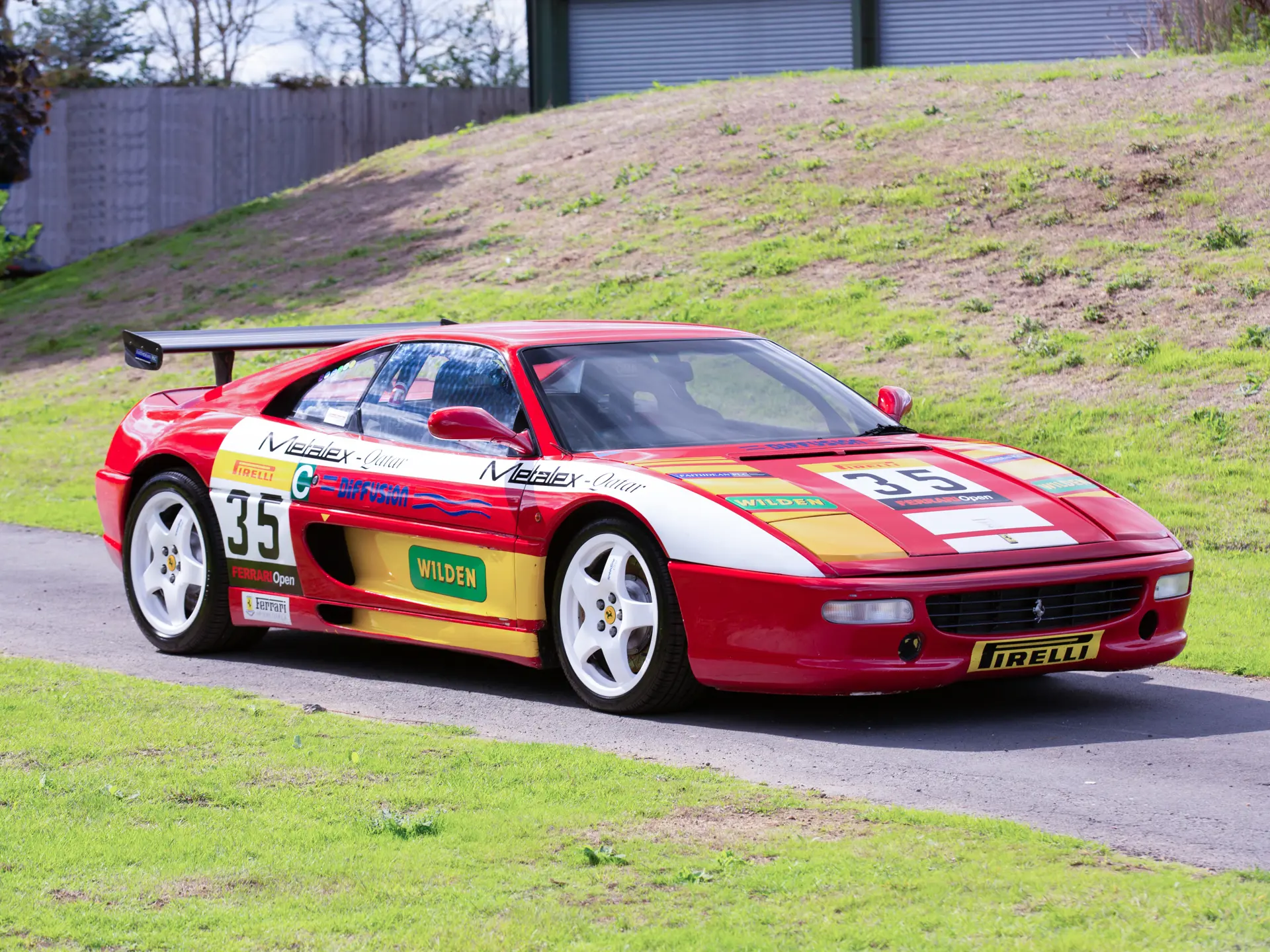
Ferrari 355 Challenge
Ferrari's factory race series 355 — stripped, caged, and intended for the circuit.
Live market · 355live data
Sold figures are last 12 months. For-sale figures are right now.
- For sale now
- 8
- For-sale median
- $185,260
- Sold (12 mo)
- 4
- Sold median
- $178,288
7.4% of ~108 built
Avg $186,886
recorded transactions
Avg $187,063
Specifications
- Engine
- Tipo F129B — 90° V8, unchanged from road car
- Displacement
- 3,495 cc (3.5 L)
- Valvetrain
- DOHC, five valves per cylinder
- Power
- 375 PS (380 hp) — factory-sealed, no power increase
- Torque
- 363 Nm (268 lb-ft)
- Redline
- 8,500 rpm
- Transmission
- 6-speed manual, gated, with Challenge gear ratios on later kits
- Drivetrain
- Rear-wheel drive, limited-slip differential
- Dry weight
- ~1,250 kg (2,756 lb) with full Challenge kit
- Weight distribution
- 42% front / 58% rear
- 0 – 60 mph
- Not officially quoted — comparable to road car, faster on track
- Top speed
- Gear-limited, ~280 km/h depending on circuit
- L × W × H
- 4,250 × 1,900 × 1,170 mm
- Wheelbase
- 2,450 mm (96.5 in)
- Fuel capacity
- 82 L road tank or FIA fuel cell on full race cars
- Boot space
- Deleted — battery and fire system live in the front compartment
- Chassis
- Standard 355 spaceframe with bolt-in roll cage
- Suspension
- Stiffer springs, race dampers, lower ride height, adjustable anti-roll bars
- Brakes
- Larger Brembo race calipers, slotted/grooved discs, race pads
- Wheels
- 18" Speedline magnesium centre-lock or five-spoke (kit dependent)
- Tyres
- Pirelli P Zero Corsa (period-correct) — slick or treaded
- Price new
- Conversion kit ~$30,000 USD over a donor Berlinetta
Owners Perspective
What it's like to live with
The Challenge is what the road 355 wants to be when you stop caring about insulation, carpet, and a passenger. It is loud, it is hot, it is uncompromising, and on a track it is the most rewarding 355 there is. As a road car it makes no sense; as a circuit machine with history, it is one of the great '90s racing Ferraris.
What owners love
- Factory motorsport history. A genuine Challenge car raced in a one-make series sanctioned by Ferrari — the provenance is the value.
- The stripped interior, exposed fuel cell plumbing, and Lexan rear screen turn it into a totally different car than the road Berlinetta.
- Same engine, lighter weight, race brakes — the fastest 355 you can drive on a circuit, full stop.
- Eligible for historic and modern club race series, plus track-day groups that don't accept later cars.
- A well-documented Challenge with FIA papers and period race history is a genuine collector item.
What owners live with
- Not road-legal in most jurisdictions without significant work. Many Challenge cars have been converted back, partially or fully — provenance documentation matters.
- Race fuel cells have a service life. A car sitting on an out-of-date cell is a five-figure problem before you turn a wheel.
- Cage installation can mask chassis damage. A pre-purchase inspection is non-negotiable on any Challenge.
- Parts supply for the dedicated race kit (uprights, brakes, dampers) is specialist and expensive.
- Price discovery is hard. There is no straight comparable for a documented Challenge — the market is small and trades happen privately.
Build variants timeline
What changed, year by year
The 1994 – 1999 production run, in order. Three-spoke to airbag wheel, Motronic 2.7 to 5.2, the F1 gearbox, the Spider, the Serie Fiorano — when each spec arrived.
Read the timeline →
Transmissions
Manual, F1 & conversions
Gated 6-speed manual, F1 paddle-shift automated manual, and the increasingly common F1-to-manual conversion. Different cars to live with, different cars to value.
Read the transmission guide →
Buying tips
- 01Demand the build sheet, the original Challenge kit invoice, and any FIA / FCA papers. No paperwork = a converted road car, not a Challenge.
- 02Verify the chassis number against the official Ferrari Challenge production list.
- 03Inspect the cage welds and the chassis around the cage mounting points for repair.
- 04Check the fuel cell expiry date and ask when the rosette / bag was last replaced.
- 05Ask whether the car has been crashed and re-shelled — common in this generation, and it materially affects value.
Other models